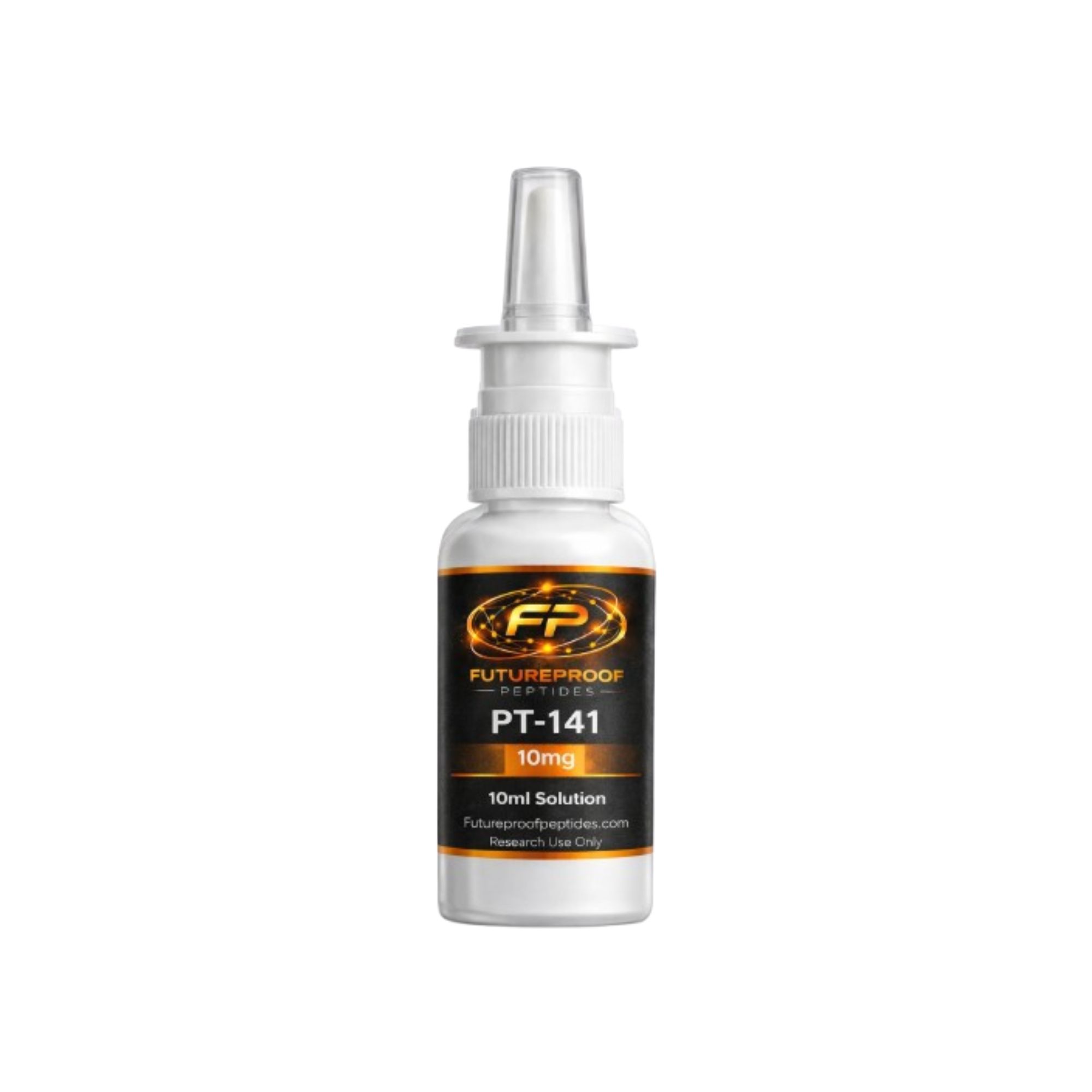
PT-141 10mg Spray – Advanced Bremelanotide Research Peptide
PT-141 10mg Spray is a research formulation containing PT-141, also known as bremelanotide, a synthetic peptide investigated extensively within melanocortin receptor research, neuroendocrine biology, behavioural neuroscience, and reproductive physiology.
PT-141 has attracted scientific interest because its activity is associated primarily with melanocortin receptor signalling rather than the direct vascular mechanisms associated with some other compounds investigated in reproductive research. This makes PT-141 10mg Spray a useful research material for scientists examining the relationship between melanocortin pathways, central nervous system signalling, and behavioural responses.
PT-141 originated from research involving melanocortin peptides and was subsequently investigated independently because of its distinct pharmacological profile. Scientific research has examined its interaction with melanocortin receptor subtypes, particularly pathways associated with the central nervous system.
The PT-141 10mg Spray format provides a defined research formulation for laboratory and analytical investigation. Research involving this format may include studies of peptide formulation, stability, receptor pharmacology, neuroendocrine signalling, and behavioural physiology.
This product is supplied strictly for laboratory and scientific research purposes.
For research use only. Not for human use. Not for veterinary use.
What Is PT-141 10mg Spray?
PT-141 10mg Spray contains PT-141, a synthetic peptide commonly known by the name bremelanotide.
PT-141 belongs to the broader field of melanocortin research. Melanocortins are a family of peptides involved in multiple biological signalling pathways.
Researchers have investigated PT-141 because of its interaction with melanocortin receptors and the resulting signalling activity.
Research areas associated with PT-141 include:
- Melanocortin receptor pharmacology
- Neuroendocrine signalling
- Behavioural neuroscience
- Central nervous system research
- Hypothalamic signalling
- Reproductive physiology
- Motivational behaviour
- Peptide-receptor interactions
- Hormonal communication
The spray format adds an additional area of interest because researchers can investigate a prepared formulation rather than only studying the peptide in its raw form.
Understanding PT-141
PT-141 is a synthetic cyclic peptide derived from research into melanocortin signalling.
Its development followed investigations into melanocortin analogues and their biological activity. Researchers subsequently identified properties that made PT-141 particularly interesting for studies involving central melanocortin pathways.
Although PT-141 and Melanotan II share a research history, they should not be treated as identical compounds.
Melanotan II has historically been associated with pigmentation research, while PT-141 became particularly notable for research involving melanocortin pathways associated with behavioural and neuroendocrine processes.
This distinction is important when evaluating PT-141 10mg Spray as a research material.
PT-141 and Melanocortin Receptors
The scientific importance of PT-141 is closely connected with melanocortin receptors.
Melanocortin receptors are a group of G-protein-coupled receptors involved in several biological signalling systems.
Different receptor subtypes have different distributions and biological roles.
Research involving PT-141 can therefore examine:
- Receptor binding
- Receptor activation
- Signal transduction
- Receptor selectivity
- Central melanocortin pathways
- Downstream cellular signalling
Understanding these interactions can help researchers investigate how synthetic melanocortin peptides influence biological systems.
How PT-141 Acts in Research
The primary research mechanism associated with PT-141 10mg Spray involves melanocortin receptor agonism.
Research indicates that PT-141 interacts with melanocortin receptor pathways, with particular interest surrounding central nervous system signalling.
Rather than being primarily studied as a direct vascular compound, PT-141 has been investigated for how melanocortin receptor activation may influence neural and behavioural pathways.
Researchers can therefore use PT-141 in experimental models examining:
- Neural signalling
- Receptor activation
- Neuroendocrine communication
- Hypothalamic pathways
- Behavioural responses
- Reproductive physiology
The exact biological response depends on the experimental model and research conditions.
PT-141 10mg Spray and Neuroendocrine Research
Neuroendocrine research examines the relationship between the nervous system and endocrine signalling.
The hypothalamus plays an important role in coordinating neurological and hormonal communication.
Because melanocortin receptors are expressed within neural pathways, PT-141 has become an interesting experimental compound for researchers studying the interaction between melanocortin signalling and neuroendocrine systems.
Research involving PT-141 10mg Spray may investigate:
- Hypothalamic signalling
- Neuroendocrine communication
- Hormonal pathways
- Central receptor activity
- Neural signalling
- Behavioural responses
These studies contribute to a broader understanding of how peptide signalling can influence complex biological systems.
PT-141 and Behavioural Research
One of the major areas of scientific interest surrounding PT-141 is behavioural research.
Researchers have investigated how melanocortin receptor activation may influence behavioural responses in experimental models.
This research is particularly relevant to understanding the relationship between central nervous system signalling and motivational behaviour.
Potential research areas include:
- Behavioural motivation
- Sexual behaviour models
- Neural reward pathways
- Central melanocortin signalling
- Neuroendocrine responses
- Reproductive behaviour
The findings from these studies remain dependent on the specific experimental model and should not be interpreted as guaranteed outcomes in humans.
PT-141 and Reproductive Physiology Research
PT-141 has received considerable scientific attention within reproductive physiology research.
Researchers have investigated melanocortin signalling as part of the complex network of biological pathways associated with reproductive behaviour and physiological responses.
The research focus can include:
- Reproductive signalling
- Sexual behaviour models
- Central nervous system pathways
- Hormonal communication
- Motivational behaviour
- Melanocortin receptor activity
The purpose of this research is to better understand the underlying biological mechanisms rather than to establish a research product as a treatment.
PT-141 and Central Nervous System Research
The central nervous system is one of the most important areas of PT-141 research.
Melanocortin receptors are present within neural tissues, including regions involved in behavioural and endocrine regulation.
Researchers can investigate how PT-141 interacts with these systems and how receptor activation influences downstream signalling.
Research may examine:
- Neuronal communication
- Central receptor activity
- Hypothalamic pathways
- Neuroendocrine signalling
- Behavioural responses
- Peptide-mediated signalling
This makes PT-141 10mg Spray particularly relevant to experimental studies that investigate peptide signalling within the nervous system.
PT-141 and Hypothalamic Research
The hypothalamus is a major regulatory region of the brain involved in endocrine, metabolic, behavioural, and physiological processes.
Melanocortin pathways within the hypothalamus have been investigated in relation to several biological functions.
PT-141 provides researchers with an experimental compound for studying melanocortin signalling within these pathways.
Research may explore:
- Hypothalamic receptor activity
- Hormonal signalling
- Behavioural regulation
- Neuroendocrine communication
- Central melanocortin pathways
These studies can help scientists better understand how peptide signalling contributes to complex physiological regulation.
PT-141 and Sexual Behaviour Research
Sexual behaviour research is one of the most frequently discussed areas involving PT-141.
Scientific investigations have examined whether melanocortin receptor activation can influence behavioural responses associated with sexual motivation.
The research is particularly interesting because the proposed mechanism differs from compounds that primarily influence peripheral vascular pathways.
Researchers can investigate:
- Sexual motivation
- Behavioural responses
- Central melanocortin signalling
- Neuroendocrine communication
- Receptor-mediated pathways
These observations remain within the context of scientific research and should not be interpreted as proof of therapeutic effectiveness for any individual.
PT-141 and Blood Flow Research
PT-141 is sometimes discussed alongside compounds associated with vascular mechanisms.
However, the primary research interest in PT-141 relates to melanocortin receptor signalling.
This distinction is important.
Research into PT-141 can help scientists investigate how central nervous system pathways may contribute to physiological responses without treating the compound as simply a blood-flow regulator.
Researchers may therefore compare:
- Central receptor signalling
- Peripheral vascular mechanisms
- Neuroendocrine pathways
- Behavioural responses
- Hormonal signalling
This comparative approach can improve understanding of the different mechanisms involved in reproductive and behavioural physiology.
PT-141 Compared With Melanotan II
PT-141 and Melanotan II are related synthetic melanocortin peptides, but their research profiles are not identical.
Melanotan II became strongly associated with research into pigmentation and melanogenesis.
PT-141, meanwhile, became particularly notable for investigations involving central melanocortin signalling and behavioural physiology.
This difference makes PT-141 10mg Spray a distinct research material even though the two compounds share a common developmental background.
Researchers should always distinguish between the molecular identity, receptor activity, and intended research application of each compound.
PT-141 and Receptor Pharmacology
Receptor pharmacology examines how compounds interact with receptors and influence downstream biological signalling.
PT-141 provides researchers with an experimental model for studying melanocortin receptor pharmacology.
Laboratory investigations may evaluate:
- Binding characteristics
- Receptor activation
- Agonist activity
- Receptor selectivity
- Intracellular signalling
- Cellular responses
These studies can help researchers understand how synthetic peptides influence receptor-mediated biological processes.
PT-141 10mg Spray and Formulation Research
The spray format introduces another dimension to research.
A peptide formulation is influenced not only by the active compound but also by factors such as concentration, excipients, container characteristics, environmental conditions, and storage.
Research involving PT-141 10mg Spray can therefore examine:
- Formulation stability
- Spray characteristics
- Product uniformity
- Container compatibility
- Peptide integrity
- Storage stability
- Analytical consistency
These investigations are useful when evaluating how a peptide behaves within a specific formulation.
Why Researchers Study PT-141 10mg Spray
The PT-141 10mg Spray format combines a well-known experimental melanocortin peptide with a defined spray presentation.
Researchers may select this type of formulation when their experimental objectives involve:
- Melanocortin receptor research
- Neuroendocrine biology
- Behavioural neuroscience
- Reproductive physiology
- Peptide pharmacology
- Formulation research
- Stability testing
- Analytical investigation
The defined 10mg quantity also provides a consistent reference point for laboratory documentation.
The stated quantity should not be interpreted as a recommended human administration amount.
PT-141 10mg Spray Research Applications
The potential research applications associated with PT-141 10mg Spray include several areas of experimental science.
Melanocortin Receptor Research
Investigation of receptor activation, binding, signalling, and pharmacology.
Neuroendocrine Research
Study of interactions between neural and endocrine signalling systems.
Behavioural Neuroscience
Investigation of behavioural responses associated with central melanocortin pathways.
Reproductive Physiology
Research into biological pathways associated with reproductive and sexual behaviour models.
Hypothalamic Research
Study of melanocortin signalling within hypothalamic pathways.
Peptide Pharmacology
Investigation of synthetic peptide-receptor interactions.
Cellular Signalling
Study of downstream signalling mechanisms following receptor activation.
Formulation Research
Evaluation of spray formulation characteristics and stability.
PT-141 10mg Spray and Analytical Research
Analytical research is important when evaluating peptide identity and formulation quality.
Researchers may use validated analytical methods to examine characteristics such as:
- Peptide identity
- Purity
- Concentration
- Stability
- Formulation consistency
- Degradation
- Batch variation
Consistent analytical procedures can help researchers determine whether experimental materials remain within the expected specifications throughout a study.
Research Quality and Reproducibility
Reliable research depends on reproducible experimental conditions.
When working with PT-141 10mg Spray, researchers should maintain detailed records covering the material and experimental environment.
Useful records may include:
- Product name
- Batch or lot number
- Quantity
- Storage conditions
- Formulation information
- Experimental conditions
- Analytical method
- Observation period
- Research model
- Results
Maintaining complete documentation can help researchers identify potential sources of variation.
Storage and Laboratory Handling
The PT-141 10mg Spray should be stored according to the specific conditions supplied with the product and batch.
General laboratory handling considerations include protecting peptide formulations from excessive heat, moisture, direct light, and unnecessary environmental exposure.
Researchers should:
- Follow the specified storage conditions
- Protect the formulation from excessive heat
- Avoid unnecessary temperature fluctuations
- Keep the container appropriately sealed
- Minimise exposure to moisture
- Protect the formulation from direct light
- Follow appropriate laboratory procedures
Specific stability characteristics can vary according to formulation and packaging.
PT-141 10mg Spray Stability Research
Stability research examines whether a peptide formulation maintains its expected characteristics over time.
Researchers may investigate how environmental conditions influence the formulation.
Potential stability variables include:
- Temperature
- Light
- Moisture
- Storage duration
- Container compatibility
- Formulation composition
- Peptide integrity
Analytical testing can be used to evaluate whether measurable changes occur during storage.
Safety Information
PT-141 is an experimental peptide with a pharmacological profile that has been investigated in clinical and preclinical research.
Research involving PT-141 has reported adverse reactions, and the appropriate interpretation of those findings depends on the specific study, formulation, exposure, and population.
The long-term safety implications of experimental use should not be assumed from limited research.
The PT-141 10mg Spray should therefore be treated strictly as a laboratory research material.
Researchers should consult applicable safety documentation and use appropriate laboratory risk-management procedures.
Limitations of PT-141 Research
Although PT-141 has been studied for many years, research limitations remain.
Results can vary depending on:
- Experimental model
- Study population
- Concentration
- Exposure period
- Receptor expression
- Formulation
- Experimental conditions
- Analytical methodology
Findings from animal or cellular models should not automatically be interpreted as equivalent to human outcomes.
Similarly, findings from one formulation cannot necessarily be applied to another formulation.
PT-141 10mg Spray Product Specifications
Product: PT-141 / Bremelanotide
Product format: PT-141 10mg Spray
Quantity: 10mg
Classification: Synthetic melanocortin peptide
Research focus: Melanocortin receptor signalling
Research areas: Neuroendocrine signalling, behavioural neuroscience, reproductive physiology, receptor pharmacology, cellular signalling, formulation research
Form: Spray formulation
Intended use: Laboratory and scientific research
Human use: Not intended
Veterinary use: Not intended
Frequently Asked Questions
What is PT-141 10mg Spray?
PT-141 10mg Spray is a research formulation containing PT-141, also known as bremelanotide, a synthetic melanocortin peptide investigated in neuroendocrine, behavioural, and receptor-signalling research.
What is PT-141?
PT-141 is a synthetic peptide associated with melanocortin receptor research and has been investigated particularly in relation to central nervous system and behavioural pathways.
What is bremelanotide?
Bremelanotide is the name commonly used for PT-141.
What receptors does PT-141 interact with?
PT-141 has been investigated for its activity at melanocortin receptor pathways, with research interest particularly surrounding central melanocortin signalling.
Why is PT-141 researched?
Researchers investigate PT-141 in areas including melanocortin receptor pharmacology, neuroendocrine signalling, behavioural neuroscience, reproductive physiology, and central nervous system research.
Is PT-141 the same as Melanotan II?
No. PT-141 and Melanotan II are related synthetic melanocortin peptides, but they have different research profiles and areas of scientific interest.
What is the difference between PT-141 and Melanotan II?
Melanotan II has historically been investigated heavily in pigmentation and melanogenesis research, while PT-141 has attracted particular interest in central melanocortin, behavioural, and neuroendocrine research.
Is PT-141 studied in behavioural research?
Yes. Scientific studies have investigated PT-141 in experimental models involving behavioural responses and central melanocortin signalling.
Is PT-141 studied in reproductive research?
Yes. PT-141 has been investigated in experimental research involving reproductive physiology and sexual behaviour pathways.
Is PT-141 primarily a blood-flow research compound?
No. Its primary research interest is associated with melanocortin receptor signalling, particularly central pathways, rather than treating it simply as a direct vascular compound.
What does the 10mg specification mean?
The 10mg specification identifies the stated quantity of PT-141 in the research formulation. It is not a recommended human administration amount.
What form is PT-141 10mg Spray supplied in?
PT-141 10mg Spray is supplied as a spray-based research formulation.
Can PT-141 be studied in formulation research?
Yes. Researchers can investigate formulation characteristics such as stability, consistency, peptide integrity, and container compatibility.
Is PT-141 10mg Spray intended for human use?
No. PT-141 10mg Spray is supplied strictly for laboratory and scientific research and is not intended for human use.
Is PT-141 10mg Spray intended for animals?
No. The product is not intended for veterinary or animal use.
Is PT-141 an approved research treatment?
Research status and regulatory status are separate considerations. A research compound should not be represented as an approved treatment simply because it has been investigated in clinical studies.
Does PT-141 have known side effects?
Research and clinical studies have reported adverse reactions associated with PT-141. The complete risk profile depends on the particular formulation, study conditions, and population.
Is the long-term safety of PT-141 established?
Long-term safety should not be assumed. Researchers should evaluate current scientific evidence and relevant safety documentation when designing experiments.
Important Research-Use Disclaimer
PT-141 10mg Spray is supplied strictly for laboratory, analytical, and scientific research purposes only.
This product is not intended for human consumption, human administration, veterinary use, cosmetic use, diagnosis, treatment, prevention, or cure of any disease or medical condition.
Information concerning PT-141, bremelanotide, melanocortin receptors, neuroendocrine signalling, behavioural neuroscience, reproductive physiology, and related biological pathways is provided for scientific and educational purposes only.
Research findings should not be interpreted as evidence that PT-141 10mg Spray is safe or appropriate for personal use.
Researchers are responsible for ensuring that their use of PT-141 10mg Spray complies with applicable laws, regulations, institutional requirements, laboratory safety procedures, and ethical standards.
For research use only. Not for human or veterinary use.