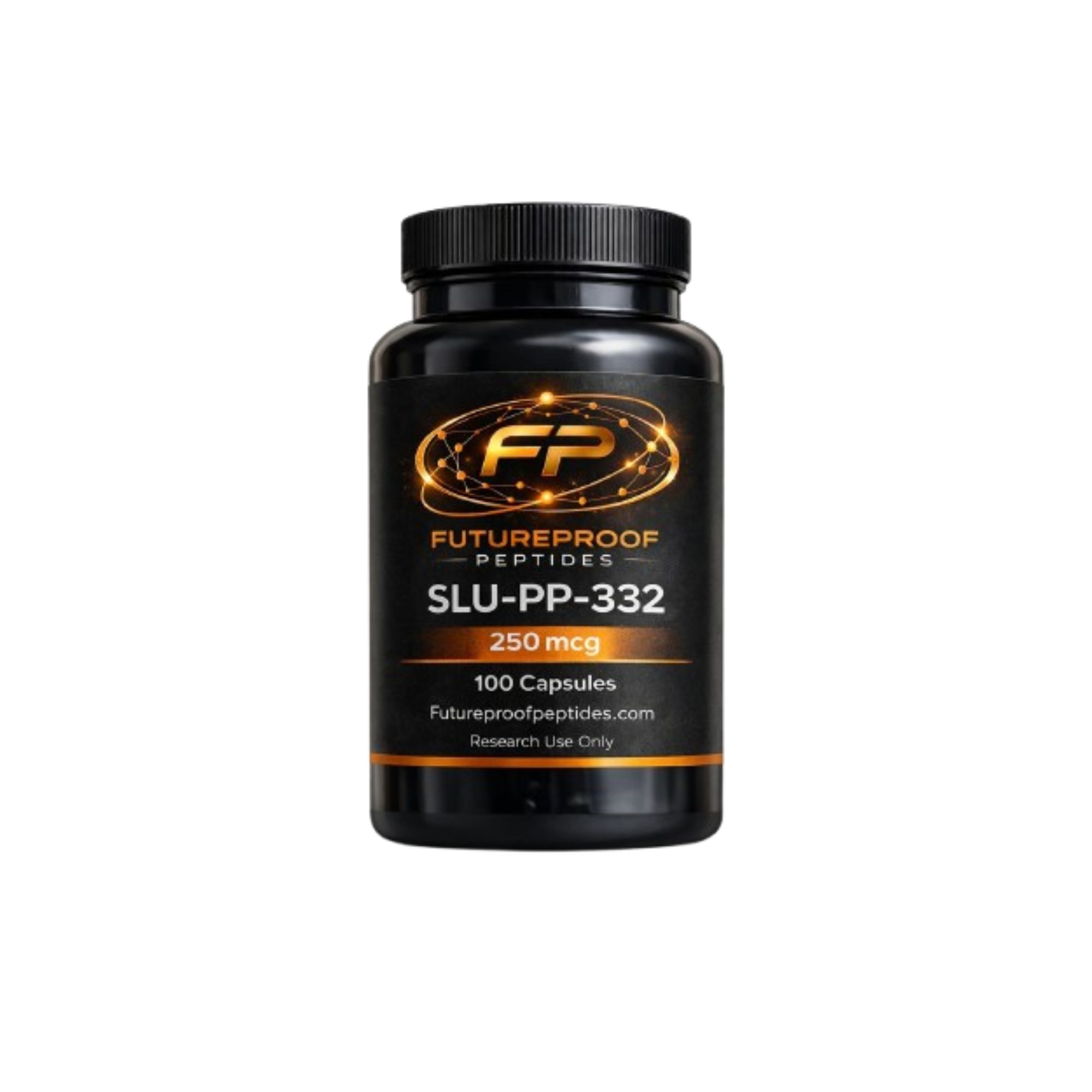
SLU-PP-332 250mcg Research Compound
SLU-PP-332 250mcg is a high-quality experimental research compound intended for laboratory investigation into cellular energy metabolism, mitochondrial biology, oxidative metabolism, and estrogen-related receptor (ERR) signalling.
Unlike conventional research peptides, SLU-PP-332 250mcg is a synthetic small molecule. It has attracted significant scientific interest because of its ability to interact with ERRα, ERRβ, and ERRγ, a group of nuclear receptors involved in regulating genes associated with cellular energy production and oxidative metabolic processes.
Research involving SLU-PP-332 250mcg has become particularly interesting in experimental models investigating exercise-related molecular pathways. Scientific studies have examined whether activating ERR signalling can reproduce certain molecular characteristics associated with aerobic exercise in preclinical models.
This has led to SLU-PP-332 being described in scientific literature as an experimental “exercise mimetic.” This terminology refers to molecular and metabolic responses observed in research models and should not be interpreted as meaning that the compound replaces physical exercise or provides an established benefit in humans.
Our SLU-PP-332 250mcg is supplied for controlled laboratory and analytical research only.
Not for human use. Not for veterinary use.
What Is SLU-PP-332 250mcg?
SLU-PP-332 250mcg is an experimental synthetic small molecule used in research involving estrogen-related receptors.
The compound is commonly described as a pan-ERR agonist because it has activity involving several ERR receptor subtypes, including ERRα, ERRβ, and ERRγ.
Estrogen-related receptors are members of the nuclear receptor family. Despite their name, ERRs are distinct from classical estrogen receptors.
These receptors are involved in regulating genes associated with:
- Cellular energy production
- Mitochondrial function
- Oxidative metabolism
- Fatty-acid utilisation
- Skeletal muscle metabolism
- Cellular energy demand
- Metabolic adaptation
Because these pathways are closely connected to mitochondrial activity and energy metabolism, SLU-PP-332 250mcg provides researchers with an experimental tool for studying how ERR signalling affects cellular processes.
SLU-PP-332 250mcg and ERR Signalling
One of the most important reasons scientists study SLU-PP-332 250mcg is its relationship with estrogen-related receptor signalling.
ERRα, ERRβ, and ERRγ are transcriptional regulators involved in controlling the expression of genes associated with energy metabolism.
ERRα, in particular, has received substantial attention because of its relationship with mitochondrial biology and oxidative metabolism.
Researchers can therefore use experimental ERR agonists to investigate how activation of these receptors influences cellular function.
Research questions may include:
- How ERR activation changes gene expression
- How mitochondrial pathways respond to ERR signalling
- How cells regulate oxidative metabolism
- How energy production changes under experimental conditions
- How skeletal muscle responds to altered metabolic signalling
- How fatty-acid oxidation pathways are regulated
The results of these experiments can help researchers better understand the molecular systems controlling cellular energy metabolism.
How SLU-PP-332 250mcg Is Studied
The research surrounding SLU-PP-332 250mcg focuses on its ability to activate ERR-related pathways.
In laboratory models, researchers can examine how ERR activation influences downstream molecular processes.
Depending on the research design, scientists may investigate:
- Gene expression
- Mitochondrial activity
- Oxygen consumption
- Energy expenditure
- Fatty-acid oxidation
- Oxidative metabolism
- Skeletal muscle metabolism
- Exercise-associated molecular pathways
These measurements allow researchers to determine how experimental activation of ERR signalling changes cellular and metabolic behaviour.
The specific observations obtained can vary significantly depending on the experimental model and research conditions.
SLU-PP-332 250mcg and Mitochondrial Research
Mitochondria are central to cellular energy metabolism.
They convert energy stored in nutrients into forms that cells can use to support biological processes.
Because ERR signalling is closely connected with genes involved in mitochondrial function, SLU-PP-332 250mcg has become an important experimental compound for mitochondrial research.
Researchers may investigate whether ERR activation changes:
- Mitochondrial activity
- Oxidative capacity
- Cellular energy production
- Metabolic flexibility
- Fatty-acid utilisation
- Oxygen consumption
- Energy demand
This provides an opportunity to examine how nuclear receptor signalling and mitochondrial function interact.
SLU-PP-332 250mcg and Cellular Energy Metabolism
Cellular metabolism describes the network of chemical reactions cells use to obtain and utilise energy.
Different tissues have different energy requirements, and those requirements can change depending on environmental and physiological conditions.
Research involving SLU-PP-332 250mcg investigates how ERR activation may influence genes and pathways involved in cellular energy metabolism.
Experimental models can examine how cells process different energy sources and how mitochondrial activity responds to changing metabolic requirements.
This makes SLU-PP-332 particularly relevant to research focused on:
- Energy production
- Oxidative metabolism
- Mitochondrial biology
- Nutrient utilisation
- Metabolic adaptation
- Cellular energy demand
SLU-PP-332 250mcg and Oxidative Metabolism
Oxidative metabolism is an important component of cellular energy production.
Mitochondria use biochemical pathways to convert nutrients into usable cellular energy. Fatty acids, carbohydrates, and other substrates can contribute to these processes.
ERR signalling is involved in regulating genes associated with oxidative metabolism.
Consequently, SLU-PP-332 250mcg is of interest to researchers investigating how changes in ERR activity influence oxidative pathways.
Laboratory research may examine:
- Oxidative capacity
- Mitochondrial respiration
- Fatty-acid oxidation
- Cellular oxygen consumption
- Metabolic substrate utilisation
- Energy expenditure
These investigations can provide insight into the molecular mechanisms underlying energy metabolism.
SLU-PP-332 250mcg and Fatty-Acid Oxidation
Fatty-acid oxidation allows cells to use fatty acids as an energy source.
This process is particularly important in tissues with high metabolic requirements, including skeletal muscle.
Researchers have investigated the relationship between ERR signalling and genes involved in fatty-acid metabolism.
SLU-PP-332 250mcg can therefore be used in experimental models designed to investigate how ERR activation affects fatty-acid utilisation.
Research may focus on changes in:
- Fatty-acid oxidation
- Mitochondrial metabolism
- Energy production
- Oxidative capacity
- Metabolic gene expression
These studies contribute to a broader understanding of how cells select and utilise different energy substrates.
SLU-PP-332 250mcg and Skeletal Muscle Research
Skeletal muscle has substantial energy requirements, particularly during physical activity.
Mitochondrial density and oxidative metabolism are therefore important subjects in muscle research.
Researchers have investigated SLU-PP-332 250mcg in experimental models involving skeletal muscle metabolism and exercise-associated molecular pathways.
Areas of interest include:
- Muscle mitochondrial activity
- Oxidative metabolism
- Energy production
- Fatty-acid utilisation
- Metabolic adaptation
- Exercise-associated signalling
These studies allow researchers to investigate the molecular mechanisms connecting ERR signalling with skeletal muscle metabolism.
The existence of research in this area does not establish SLU-PP-332 as a human performance-enhancing compound.
SLU-PP-332 250mcg and Exercise Research
Exercise produces substantial changes in cellular energy requirements.
During aerobic activity, tissues increase their demand for oxygen and energy. This results in changes to metabolic pathways and gene expression.
ERR signalling is involved in several pathways associated with these adaptations.
This is one reason SLU-PP-332 250mcg has attracted attention as an experimental exercise-related research compound.
Researchers have investigated whether activating ERR pathways can reproduce selected molecular characteristics associated with exercise in preclinical models.
This research may examine:
- Mitochondrial activity
- Oxidative metabolism
- Energy expenditure
- Exercise-associated gene expression
- Endurance-related experimental measurements
- Skeletal muscle metabolic responses
The term “exercise mimetic” should therefore be understood strictly within its experimental scientific context.
It does not mean that SLU-PP-332 is a substitute for exercise.
SLU-PP-332 250mcg and Energy Expenditure Research
Energy expenditure represents the amount of energy used by a biological system.
Researchers studying metabolism may investigate whether changes in ERR signalling influence how experimental models utilise energy.
SLU-PP-332 250mcg has been investigated in preclinical models where researchers measured metabolic parameters associated with energy expenditure.
These studies can provide information about:
- Cellular energy utilisation
- Oxidative metabolism
- Mitochondrial activity
- Substrate utilisation
- Metabolic adaptation
Such findings remain experimental and cannot automatically be translated into human outcomes.
SLU-PP-332 250mcg and Metabolic Research
Metabolic research examines how organisms and cells obtain, store, transform, and utilise energy.
ERR receptors are important regulators within several metabolic pathways.
Because of its activity at ERR receptors, SLU-PP-332 250mcg provides researchers with an experimental method for investigating how changes in ERR signalling affect metabolism.
Potential research areas include:
- Glucose metabolism
- Fatty-acid metabolism
- Oxidative metabolism
- Mitochondrial activity
- Energy expenditure
- Cellular energy balance
- Metabolic gene expression
The precise effects observed depend on the model used and the experimental conditions.
SLU-PP-332 250mcg and Metabolic Gene Expression
Nuclear receptors can influence biological processes by regulating gene expression.
ERRs are involved in transcriptional regulation of genes associated with energy metabolism and mitochondrial function.
Research involving SLU-PP-332 250mcg can therefore examine changes in gene expression following ERR activation.
Scientists may use molecular techniques to investigate changes in specific metabolic genes and pathways.
These investigations can help identify relationships between receptor activation and downstream cellular processes.
Is SLU-PP-332 250mcg a Peptide?
No.
SLU-PP-332 250mcg is not a peptide.
It is a synthetic small molecule with chemical properties that differ from lyophilised peptide research materials.
This distinction is important when considering:
- Chemical structure
- Molecular weight
- Solubility
- Preparation
- Storage
- Experimental handling
- Analytical testing
Although SLU-PP-332 may be sold alongside research peptides, it belongs to a different chemical category.
Researchers should therefore use handling and preparation procedures appropriate for the specific compound.
SLU-PP-332 250mcg Molecular Characteristics
SLU-PP-332 is a synthetic small molecule rather than a biological peptide.
Its molecular weight is approximately 290.32 g/mol.
The small-molecule structure allows researchers to investigate ERR receptor signalling using a chemically defined experimental compound.
Understanding the chemical characteristics of SLU-PP-332 250mcg is important when developing laboratory protocols, selecting analytical methods, and preparing experimental solutions.
Researchers should consult the appropriate product documentation and safety information before handling the compound.
SLU-PP-332 250mcg Research Applications
The broad research applications associated with SLU-PP-332 250mcg include several areas of molecular and metabolic science.
ERR Receptor Research
Researchers can use SLU-PP-332 to investigate activation of ERRα, ERRβ, and ERRγ.
Mitochondrial Biology
The compound can be studied in models investigating mitochondrial activity and energy metabolism.
Cellular Metabolism
Research can examine how ERR signalling affects metabolic pathways.
Oxidative Metabolism
Scientists can investigate pathways involved in oxygen-dependent energy production.
Skeletal Muscle Research
Experimental models can examine mitochondrial and metabolic responses in muscle tissue.
Exercise Physiology
Researchers can investigate molecular pathways associated with exercise-related metabolic adaptations.
Fatty-Acid Metabolism
The compound can be included in research investigating fatty-acid oxidation and energy utilisation.
Metabolic Regulation
Laboratory studies can explore how nuclear receptor signalling contributes to metabolic regulation.
Why Choose SLU-PP-332 250mcg?
The SLU-PP-332 250mcg format provides researchers with a defined quantity of an experimental ERR agonist for laboratory and analytical research.
A standardized product format can be useful when researchers need consistent material across experimental studies.
The compound’s particular relevance to ERR signalling also makes it suitable for research focused on mitochondrial biology, cellular metabolism, and exercise-associated molecular pathways.
Researchers can incorporate SLU-PP-332 250mcg into appropriately designed experimental models according to their own validated laboratory procedures.
SLU-PP-332 250mcg Product Format
SLU-PP-332 250mcg is supplied as a research compound intended for controlled laboratory investigation.
Product Specifications
Product: SLU-PP-332
Quantity: 250mcg
Compound type: Synthetic small molecule
Research classification: Experimental ERR agonist
Primary targets: ERRα, ERRβ, ERRγ
Molecular weight: Approximately 290.32 g/mol
Research areas: Mitochondrial biology, cellular metabolism, oxidative metabolism, exercise physiology, skeletal muscle research
Intended use: Laboratory and scientific research
Human use: Not intended
Veterinary use: Not intended
Laboratory Handling of SLU-PP-332 250mcg
Because SLU-PP-332 250mcg is a synthetic small molecule, researchers should follow laboratory procedures appropriate for small-molecule research compounds.
Preparation requirements may depend on the experimental design, analytical methodology, solvent compatibility, concentration requirements, and intended research application.
Researchers should consult the relevant product documentation and Safety Data Sheet before handling the compound.
All preparation should be performed by appropriately trained personnel within suitable laboratory environments.
This product page does not provide human administration, injection, dosing, or personal-use instructions.
Storage of SLU-PP-332 250mcg
Proper storage is an important part of maintaining research material integrity.
Researchers should follow the storage conditions supplied with the specific product and batch.
General laboratory considerations include:
- Protecting the compound from excessive heat
- Protecting the material from direct light
- Maintaining appropriate environmental conditions
- Limiting unnecessary exposure to moisture
- Keeping the container properly sealed
- Following laboratory chemical-storage procedures
- Avoiding unnecessary temperature fluctuations
Storage requirements may vary according to formulation and packaging.
Researchers should always prioritize the manufacturer’s product documentation and applicable laboratory procedures.
Research Quality and Reproducibility
Reliable research requires consistent experimental materials.
Small differences in compound identity, purity, concentration, storage, or preparation can affect experimental outcomes.
For SLU-PP-332 250mcg, researchers should maintain appropriate records including:
- Product identification
- Batch or lot information
- Quantity
- Storage conditions
- Preparation details
- Experimental concentration
- Research model
- Exposure period
- Analytical method
- Experimental results
Maintaining detailed records can improve reproducibility and make it easier to compare findings across experiments.
Safety and Limitations of SLU-PP-332 250mcg
SLU-PP-332 250mcg is an experimental research compound and does not have an established human safety profile.
Available research has primarily focused on laboratory and preclinical models.
Therefore, it would be inappropriate to describe SLU-PP-332 as proven safe or to provide a definitive list of human side effects.
Researchers should assess the compound according to appropriate laboratory safety procedures and consult the relevant Safety Data Sheet before use.
Experimental findings should also be interpreted carefully because results can vary between different research models.
Understanding the Research Evidence
Research involving SLU-PP-332 250mcg includes experimental investigations into ERR signalling, mitochondrial function, energy metabolism, and exercise-related molecular pathways.
However, research findings should always be considered within their appropriate scientific context.
A result observed in a cell model may not necessarily occur in an animal model.
Likewise, findings from animal research cannot automatically be assumed to apply to humans.
Variables such as species, tissue type, concentration, exposure period, experimental conditions, and study design can all influence results.
Frequently Asked Questions
What is SLU-PP-332 250mcg?
SLU-PP-332 250mcg is an experimental synthetic small molecule used in laboratory research involving ERR signalling, mitochondrial biology, cellular metabolism, and oxidative metabolism.
Is SLU-PP-332 a peptide?
No. SLU-PP-332 250mcg is a synthetic small molecule rather than a peptide.
What does SLU-PP-332 target?
SLU-PP-332 is studied as an agonist of estrogen-related receptor subtypes ERRα, ERRβ, and ERRγ.
What are estrogen-related receptors?
Estrogen-related receptors are nuclear receptors involved in regulating genes associated with energy metabolism, mitochondrial function, and oxidative processes.
Is SLU-PP-332 an estrogen receptor?
No. Estrogen-related receptors are distinct from classical estrogen receptors despite their similar naming.
Why is SLU-PP-332 researched?
SLU-PP-332 250mcg is researched because ERR signalling is involved in cellular energy metabolism, mitochondrial function, oxidative metabolism, and other metabolic processes.
Is SLU-PP-332 studied for mitochondrial function?
Yes. Researchers have investigated SLU-PP-332 in experimental models involving mitochondrial activity and energy metabolism.
Is SLU-PP-332 studied in exercise research?
Yes. Preclinical research has investigated ERR activation and exercise-associated molecular pathways.
What does “exercise mimetic” mean?
The term describes the ability of an experimental compound to reproduce certain molecular or metabolic responses associated with exercise in research models. It does not mean that the compound replaces physical exercise.
Is SLU-PP-332 a performance-enhancing product?
No. SLU-PP-332 250mcg is supplied strictly for laboratory research and should not be marketed or represented as a human performance-enhancing product.
What is the molecular weight of SLU-PP-332?
The molecular weight of SLU-PP-332 is approximately 290.32 g/mol.
What does the 250mcg specification mean?
The 250mcg specification identifies the stated quantity of research compound supplied. It is not a recommended human administration amount.
What research areas are associated with SLU-PP-332?
Research areas include ERR signalling, mitochondrial biology, cellular energy metabolism, oxidative metabolism, fatty-acid oxidation, skeletal muscle research, exercise physiology, and metabolic regulation.
Does SLU-PP-332 have established human benefits?
No. SLU-PP-332 remains an experimental research compound, and preclinical findings should not be represented as established human benefits.
Is SLU-PP-332 safe for humans?
There is no established human safety profile sufficient to recommend human use. This product is supplied exclusively for laboratory research.
Is SLU-PP-332 intended for animals?
No. SLU-PP-332 250mcg is not intended for veterinary or animal use.
Important Research-Use Disclaimer
SLU-PP-332 250mcg is supplied strictly for laboratory, analytical, and scientific research purposes only.
This product is not intended for human consumption, human administration, veterinary use, diagnosis, treatment, prevention, or cure of any disease or medical condition.
Information concerning ERR signalling, mitochondrial biology, cellular metabolism, oxidative metabolism, skeletal muscle research, exercise physiology, fatty-acid oxidation, or metabolic regulation is provided for scientific and educational purposes only.
The term “exercise mimetic” refers to experimental molecular responses observed in preclinical research and should not be interpreted as a claim that SLU-PP-332 replaces exercise or provides an established human performance benefit.
Researchers are responsible for ensuring that their use of SLU-PP-332 250mcg complies with applicable laws, regulations, institutional requirements, laboratory safety procedures, and ethical standards.
For research use only. Not for human or veterinary use.