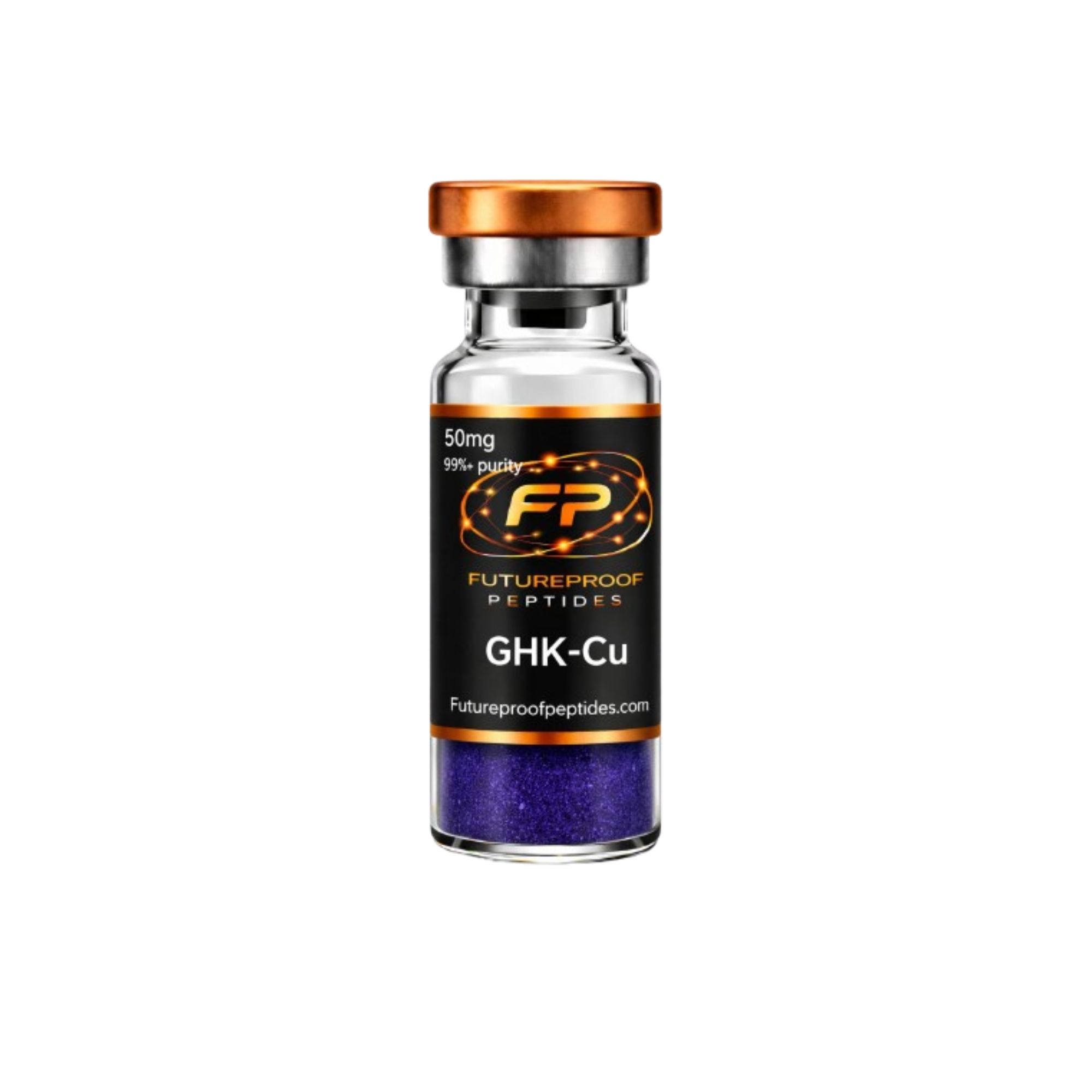
GHK-Cu 100mg Research Peptide
GHK-Cu 100mg is a copper peptide complex consisting of glycyl-L-histidyl-L-lysine (GHK) bound to copper ions. GHK-Cu is a naturally occurring peptide complex that has been identified in human plasma and has attracted significant interest within scientific research involving peptide biology, copper-dependent signalling, and skin biology.
As a research material, GHK-Cu provides researchers with an opportunity to investigate the relationship between peptide structure, copper binding, cellular signalling, and biological processes in controlled laboratory environments. Scientific interest in GHK-Cu has developed across several decades, particularly in research involving skin-associated biology, extracellular matrix processes, cellular activity, and peptide-mediated signalling.
GHK-Cu 100mg is supplied as a research-use material for laboratory and scientific investigation. The product is intended to support controlled experimental work where researchers require a copper-associated peptide complex for research purposes.
For research use only. Not for human or animal use.
GHK-Cu 100mg Research Overview
GHK-Cu combines a short peptide known as GHK with copper ions to form a copper peptide complex.
GHK is a naturally occurring tripeptide composed of three amino acids:
- Glycine
- Histidine
- Lysine
The ability of GHK to bind copper is an important characteristic of the complex and is central to scientific interest surrounding GHK-Cu.
Research has investigated GHK-Cu in relation to a variety of biological pathways, particularly those associated with skin biology and cellular signalling. Researchers have also examined its interactions with biological systems involving extracellular matrix components, cellular responses, and copper-dependent processes.
The presence of GHK-Cu in human plasma has contributed to scientific interest in the compound. However, the presence of a substance naturally within the human body does not by itself establish that administering additional amounts produces a particular biological or therapeutic outcome.
For this reason, GHK-Cu research should be evaluated according to the specific experimental system, concentration, methodology, and research objective involved.
What Is GHK-Cu?
GHK-Cu is the copper-bound form of the naturally occurring tripeptide GHK.
The GHK peptide is composed of glycine, histidine, and lysine. These amino acids form a small peptide sequence capable of interacting with copper ions.
Copper is an essential trace element involved in numerous biological processes. It participates in enzyme activity, protein function, cellular metabolism, and other biochemical pathways.
The interaction between GHK and copper produces a peptide complex that has become an important subject of laboratory investigation.
GHK-Cu is therefore distinct from GHK alone. When studying experimental results, researchers should consider whether a particular scientific publication examined free GHK, copper-bound GHK, or another copper-peptide formulation.
This distinction is important because peptide structure and metal binding can influence biological behaviour.
GHK-Cu and Human Plasma
One of the characteristics that has contributed to interest in GHK-Cu is its identification in human plasma.
Researchers have investigated naturally occurring GHK and GHK-Cu as components of human biological systems. Studies of naturally occurring peptide concentrations and changes associated with biological processes have helped establish a foundation for further investigation.
The discovery of GHK-Cu in human plasma provides useful information about its biological occurrence, but it should not be interpreted as proof that a laboratory product has a medical or therapeutic effect.
Research involving naturally occurring compounds must always distinguish between observing a molecule within a biological system and establishing the consequences of experimentally altering its concentration.
GHK-Cu and Copper Binding
Copper binding is one of the defining characteristics of GHK-Cu.
The GHK peptide contains amino acid residues capable of coordinating with copper ions. This interaction creates a copper-peptide complex that can be investigated from both biochemical and biological perspectives.
Researchers may study copper binding to better understand:
- Peptide-metal interactions
- Molecular structure
- Copper coordination
- Peptide stability
- Biological signalling
- Cellular responses
- Protein and enzyme interactions
- Metal-dependent biochemical processes
Understanding these interactions can provide valuable information about how short peptides participate in biological systems.
Research Into Skin Biology
GHK-Cu has received considerable scientific attention in the field of skin biology.
Research has investigated the peptide complex in experimental models relating to cellular activity, extracellular matrix biology, and processes associated with skin tissue.
The extracellular matrix is a complex network of proteins and other molecules surrounding cells. It contributes to tissue structure and influences cellular behaviour.
Because GHK-Cu has been studied in connection with extracellular matrix-related processes, it has become a subject of interest for researchers examining the relationship between peptide signalling and tissue biology.
These studies provide a foundation for laboratory investigation but should not be interpreted as evidence that GHK-Cu is an established cosmetic treatment or medical therapy.
Research Into Peptide Signalling
Peptide signalling is another area in which GHK Cu has attracted scientific interest.
Short peptides can interact with biological molecules and participate in signalling processes. Researchers investigate these interactions to better understand how peptides may influence cellular behaviour.
GHK Cu provides an interesting research model because it combines a short peptide sequence with a metal ion.
This allows researchers to investigate both peptide-mediated and copper-associated biochemical processes.
Experimental studies may examine changes in cellular activity, gene expression, protein interactions, or other measurable biological markers.
The results of such research can contribute to a broader understanding of peptide signalling without necessarily establishing a clinical application.
Extracellular Matrix Research
The extracellular matrix plays an important role in maintaining the structure and function of tissues.
Researchers studying GHK Cu have investigated its relationship with extracellular matrix-associated processes. These investigations are relevant to peptide biology because cellular behaviour is closely connected with the surrounding extracellular environment.
Research may examine proteins and signalling pathways involved in extracellular matrix regulation, cellular communication, and tissue-associated biological processes.
GHK-Cu therefore provides researchers with an experimental material for studying how small peptide complexes interact with complex biological systems.
Cellular Research
It is also relevant to laboratory research involving cellular biology.
Cell-based research can help scientists investigate how experimental compounds interact with cells under controlled conditions.
Researchers may examine parameters such as:
- Cellular viability
- Cellular signalling
- Protein expression
- Gene expression
- Cellular migration
- Extracellular matrix markers
- Oxidative processes
- Copper-dependent pathways
Results depend heavily on the cell type, experimental conditions, concentration, exposure time, and analytical method used.
Consequently, findings from one cellular model cannot automatically be generalized to all biological systems.
GHK-Cu and Peptide Biology
It is particularly interesting from a peptide biology perspective because of its small molecular structure and copper-binding properties.
Unlike larger proteins, short peptides can provide relatively simple experimental models for studying molecular recognition, signalling, and interactions with metal ions.
Researchers may use it to explore questions surrounding:
- Structure-function relationships
- Peptide-metal interactions
- Biological signalling
- Cellular communication
- Copper-dependent mechanisms
- Peptide stability
- Molecular interactions
These areas contribute to the broader scientific study of peptides and their roles within biological systems.
Why Researchers Study GHK-Cu
The research interest surrounding GHK Cu is based on several characteristics.
First, GHK is a naturally occurring peptide sequence. Second, GHK has the ability to bind copper ions. Third, GHK Cu has been detected within human biological systems. Finally, researchers have investigated the complex across several areas of laboratory biology.
Together, these characteristics make GHK Cu a useful subject for continued experimental research.
However, scientific interest should not be confused with established clinical effectiveness.
Research materials are used to investigate biological questions. The purpose of experimental research is to determine whether observations can be reproduced, under what conditions they occur, and what mechanisms may be responsible.
GHK-Cu 100mg Product Characteristics
GHK Cu 100mg is supplied as a research peptide material containing the copper-bound GHK complex.
The 100mg designation identifies the stated quantity of product supplied.
Key characteristics include:
Product: GHK Cu
Quantity: 100mg
Type: Copper peptide complex
Peptide: Glycyl-L-histidyl-L-lysine
Copper association: Copper-bound peptide complex
Format: Research-use material
Intended application: Laboratory and scientific research
Human use: Not intended
Animal use: Not intended
Researchers should always consult the specific batch documentation supplied with their material for batch-specific information.
Quality and Research Consistency
Consistency is an important consideration when conducting laboratory research.
Experimental results can be affected by variations in the materials used, making appropriate characterization and documentation valuable components of scientific research.
When working with GHK Cu, researchers may consider factors such as:
- Peptide identity
- Copper-peptide composition
- Purity
- Batch information
- Physical presentation
- Storage conditions
- Analytical documentation
Maintaining accurate batch records can help researchers associate experimental observations with the specific research material used.
For laboratories conducting repeat experiments, consistent sourcing and appropriate documentation can also contribute to reproducibility.
GHK-Cu in Experimental Research
GHK Cu can be incorporated into laboratory research investigating peptide-metal complexes and biological signalling.
Depending on the research design, scientists may use experimental systems to investigate the molecular and cellular characteristics of the compound.
Potential research areas include:
Peptide-Metal Chemistry
Researchers can investigate the interaction between the GHK peptide and copper ions, including structural and biochemical characteristics.
Cellular Signalling
Experimental systems may be used to study cellular signalling pathways associated with peptide exposure.
Skin Biology
GHK Cu has a long history of scientific interest in skin-related biological research.
Extracellular Matrix Biology
Researchers can examine the relationship between GHK Cu and extracellular matrix-associated proteins and pathways.
Molecular Biology
GHK Cu can be investigated using molecular biology techniques designed to measure changes in cellular or molecular markers.
Peptide Research
The compound provides an experimental model for researchers studying short peptides and their interactions with metal ions.
Understanding Preclinical Research
A significant portion of the scientific interest surrounding GHK Cu comes from laboratory and preclinical research.
Preclinical research can include biochemical experiments, cell studies, and other controlled experimental systems.
These studies are useful for identifying potential biological mechanisms and generating hypotheses for additional research.
However, preclinical findings cannot automatically be interpreted as evidence of safety or effectiveness in humans.
A compound may demonstrate an observable effect in a laboratory model without producing the same effect in humans. Differences in biological systems, metabolism, exposure, concentration, and experimental conditions can significantly affect results.
For this reason, GHK Cu should be approached as an experimental research compound rather than as an established therapeutic product.
Research Documentation
Proper documentation is an important part of scientific research.
Researchers using GHK Cu should maintain appropriate records relating to the research material, including batch information and relevant analytical documentation where available.
Documentation may assist with:
- Experimental reproducibility
- Batch identification
- Laboratory records
- Research comparison
- Quality control
- Experimental troubleshooting
Researchers should follow their own laboratory’s documentation requirements and applicable institutional procedures.
Storage and Laboratory Handling
GHK-Cu should be handled according to appropriate laboratory procedures for research peptide materials.
Storage requirements can vary according to the formulation, packaging, and manufacturer documentation. Researchers should therefore follow the storage conditions specified for their particular batch rather than relying on generalized storage recommendations.
Laboratory personnel should use appropriate protective procedures and follow applicable institutional safety protocols when handling research materials.
This product description does not provide instructions for human administration, injection, dosing, or personal use.
Frequently Asked Questions
What is GHK-Cu 100mg?
GHK-Cu 100mg is a copper peptide research material consisting of glycyl-L-histidyl-L-lysine associated with copper ions. It is supplied for laboratory and scientific research purposes.
What does GHK-Cu stand for?
GHK-Cu refers to the copper-bound form of GHK, a tripeptide composed of glycine, histidine, and lysine.
Is GHK-Cu naturally occurring?
GHK and GHK-Cu have been identified in human biological systems, including human plasma. This natural occurrence is one reason researchers have investigated the peptide complex.
What is GHK?
GHK is a short tripeptide consisting of three amino acids: glycine, histidine, and lysine.
What makes GHK-Cu different from GHK?
GHK-Cu is the copper-associated form of GHK. The presence of copper is a defining characteristic of the complex and is important when studying its biochemical properties.
Why is GHK-Cu researched?
Researchers have investigated GHK-Cu across areas including peptide signalling, cellular biology, skin biology, extracellular matrix processes, and peptide-metal interactions.
Is GHK-Cu a skincare treatment?
This product is not supplied as a skincare treatment. It is a research material intended exclusively for laboratory and scientific investigation.
Is GHK-Cu intended for human use?
No. GHK-Cu 100mg is strictly intended for research purposes and is not intended for human use.
Is GHK-Cu intended for animals?
No. This product is not intended for veterinary or animal use.
Does the 100mg specification refer to the product quantity?
Yes. The 100mg designation refers to the stated quantity of GHK-Cu research material supplied.
Can GHK-Cu research be used to establish medical benefits?
No. Laboratory and preclinical research findings should not be interpreted as proof of medical effectiveness or as a substitute for clinical evidence.
What areas of research involve GHK-Cu?
Research involving GHK-Cu has included peptide biology, copper binding, cellular signalling, skin biology, extracellular matrix research, and other experimental biological systems.
How should researchers evaluate GHK-Cu studies?
Researchers should consider the specific compound studied, experimental model, concentration, methodology, controls, and measured outcomes. Results from one experimental system should not automatically be generalized to another.
Research-Use Disclaimer
GHK-Cu 100mg is supplied strictly for laboratory and scientific research purposes only.
This product is not intended for human consumption, human administration, veterinary use, diagnosis, treatment, prevention, or cure of any disease or medical condition.
The scientific information presented on this page is provided for research and educational context. Descriptions of biological mechanisms or published research interests should not be interpreted as claims that GHK-Cu provides a particular medical, therapeutic, cosmetic, or performance-related benefit.
Researchers are responsible for ensuring that their use of research materials complies with applicable laws, regulations, institutional requirements, laboratory safety procedures, and ethical standards.