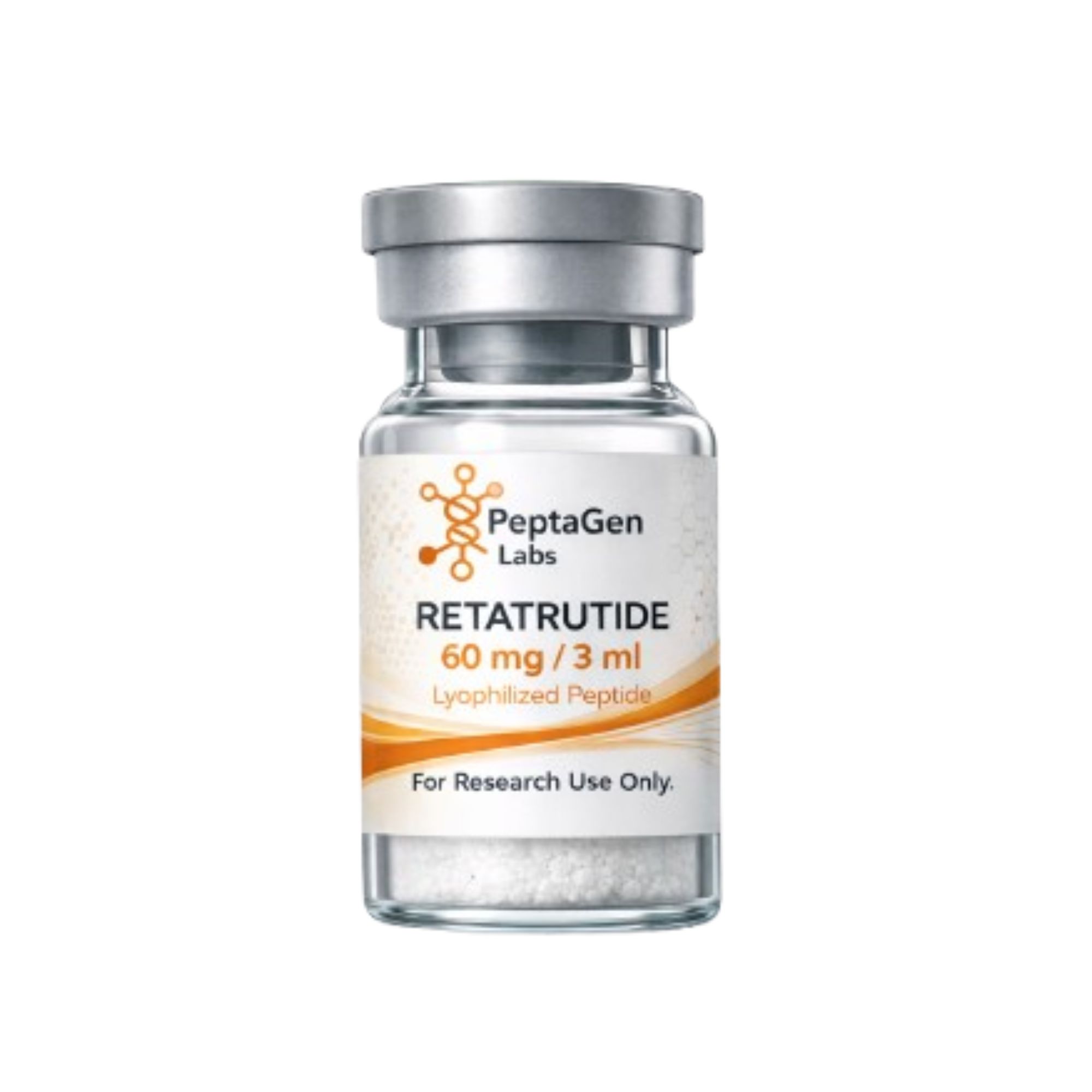
Retatrutide 60mg Research Peptide
Retatrutide 60mg is an experimental research peptide investigated for its activity across three important metabolic hormone receptor pathways: the glucagon receptor, glucagon-like peptide-1 (GLP-1) receptor, and glucose-dependent insulinotropic polypeptide (GIP) receptor.
The multi-receptor activity of Retatrutide 60mg has generated substantial scientific interest in metabolic research. Unlike compounds that primarily target a single receptor pathway, retatrutide is being studied for its combined activity across GLP-1, GIP, and glucagon signalling.
These biological pathways are associated with several aspects of metabolic regulation, including appetite signalling, glucose metabolism, energy balance, and nutrient utilisation. As a result, Retatrutide 60mg has become an important experimental material for researchers investigating how multiple hormone receptor systems interact.
Retatrutide has also attracted attention in clinical and preclinical research examining changes in body weight, metabolic markers, energy intake, and other physiological measurements. However, research findings should be interpreted within the context of the specific study design and should not be treated as established medical benefits.
Our Retatrutide 60mg is supplied as a lyophilised research peptide intended for laboratory and scientific research purposes only.
Not for human use. Not for veterinary use.
What Is Retatrutide 60mg?
Retatrutide 60mg is a synthetic peptide being investigated as a multi-receptor agonist.
Its principal research interest comes from activity at three hormone receptor systems:
- GLP-1 receptor
- GIP receptor
- Glucagon receptor
These receptors participate in interconnected biological pathways involved in metabolic regulation.
GLP-1 and GIP are incretin-related hormones that contribute to signalling associated with nutrient intake and glucose metabolism. Glucagon is involved in maintaining energy availability and regulating metabolic processes.
By investigating these pathways together, researchers can study how simultaneous receptor activation influences metabolic responses.
This makes Retatrutide 60mg particularly relevant to research involving:
- Hormone receptor signalling
- Glucose metabolism
- Appetite-related pathways
- Energy balance
- Metabolic regulation
- Nutrient utilisation
- Body-weight research models
- Endocrine signalling
How Retatrutide 60mg Works in Research
The research interest surrounding Retatrutide 60mg is based primarily on its multi-receptor activity.
GLP-1, GIP, and glucagon signalling each have different biological functions. When these pathways are investigated simultaneously, researchers can examine how their combined activation affects metabolic systems.
The GLP-1 receptor is associated with several processes involving glucose-dependent insulin secretion, gastrointestinal signalling, and appetite-related pathways.
The GIP receptor is involved in nutrient-related signalling and metabolic regulation.
The glucagon receptor is associated with pathways involved in energy mobilisation and glucose regulation.
Retatrutide’s ability to interact with all three pathways provides researchers with a distinct experimental model for studying their combined effects.
Retatrutide 60mg and GLP-1 Research
GLP-1 receptor signalling is one of the most widely studied areas of modern metabolic research.
GLP-1 is an endogenous hormone involved in signalling pathways associated with food intake, glucose metabolism, and pancreatic function.
Researchers studying Retatrutide 60mg can investigate how GLP-1 receptor activation contributes to the overall metabolic response of a multi-receptor agonist.
Research areas may include:
- GLP-1 receptor signalling
- Glucose-dependent insulin secretion
- Appetite-related signalling
- Gastric and gastrointestinal pathways
- Metabolic regulation
- Energy intake
The presence of GLP-1 activity is one reason retatrutide is frequently discussed alongside other incretin-based research compounds.
Retatrutide 60mg and GIP Research
GIP, or glucose-dependent insulinotropic polypeptide, is another hormone involved in nutrient-related signalling.
The GIP receptor is expressed in several tissues and participates in metabolic processes associated with nutrient availability.
Retatrutide 60mg provides researchers with an experimental model for studying GIP receptor activation alongside GLP-1 and glucagon pathways.
Researchers may investigate:
- GIP receptor signalling
- Glucose metabolism
- Nutrient-related hormone responses
- Metabolic regulation
- Interactions between incretin pathways
- Combined receptor activation
Studying GIP alongside GLP-1 and glucagon can provide additional insight into how multiple endocrine signals interact.
Retatrutide 60mg and Glucagon Research
The glucagon receptor represents another important component of retatrutide’s research profile.
Glucagon is involved in metabolic processes that help regulate energy availability and glucose homeostasis.
The inclusion of glucagon receptor activity differentiates retatrutide from many experimental compounds that primarily focus on incretin-related pathways.
Researchers studying Retatrutide 60mg can therefore investigate how glucagon signalling interacts with GLP-1 and GIP receptor activity.
This provides an opportunity to study:
- Glucagon receptor activation
- Energy metabolism
- Glucose regulation
- Nutrient utilisation
- Metabolic adaptation
- Multi-receptor signalling
Retatrutide 60mg and Metabolic Research
Metabolism involves a complex network of biochemical processes that determine how organisms obtain, store, and use energy.
Hormonal signalling plays an important role in regulating these processes.
Because Retatrutide 60mg activates multiple metabolic hormone receptors, it has become a significant research compound for investigating interconnected metabolic pathways.
Laboratory and clinical research may examine:
- Glucose metabolism
- Energy expenditure
- Appetite signalling
- Nutrient utilisation
- Hormone responses
- Metabolic adaptation
- Body-weight changes
These measurements can help researchers understand how combined receptor activity affects metabolic systems.
Retatrutide 60mg and Blood Glucose Research
Blood glucose regulation is an important component of metabolic research.
The GLP-1, GIP, and glucagon systems all participate in glucose-related biological processes, although they influence metabolism through different mechanisms.
Retatrutide 60mg allows researchers to investigate these pathways together.
Experimental research can examine changes in:
- Blood glucose
- Glucose tolerance
- Insulin-related responses
- Glucagon signalling
- Incretin signalling
- Overall metabolic regulation
Researchers can use these measurements to investigate how multi-receptor agonism affects glucose-related physiology.
Results can vary between research models, and observations from clinical or animal studies should not automatically be applied to other populations.
Retatrutide 60mg and Appetite Research
Appetite regulation is influenced by a complex network of hormones and neural signals.
GLP-1 and GIP-related pathways have attracted considerable research attention because of their relationship with nutrient intake and appetite signalling.
Retatrutide 60mg is investigated in this context because it combines GLP-1 and GIP activity with glucagon receptor activity.
Research may examine:
- Food intake
- Appetite-related signalling
- Satiety pathways
- Energy intake
- Hormonal responses
- Changes in metabolic behaviour
These observations help researchers investigate how multiple hormone pathways contribute to energy balance.
Retatrutide 60mg and Energy Balance
Energy balance describes the relationship between energy intake and energy expenditure.
Multiple hormonal systems participate in maintaining this balance.
Researchers are interested in Retatrutide 60mg because its multi-receptor activity provides an opportunity to investigate how GLP-1, GIP, and glucagon signalling interact with energy-regulation pathways.
Experimental studies may evaluate:
- Food intake
- Energy expenditure
- Metabolic rate
- Nutrient utilisation
- Body-weight changes
- Hormonal signalling
This research can help scientists better understand the relationship between endocrine signalling and energy metabolism.
Retatrutide 60mg and Body-Weight Research
Retatrutide has received significant attention in research involving body-weight changes.
Clinical studies have investigated the effects of retatrutide on body weight and other metabolic measurements.
However, Retatrutide 60mg should not be described as a weight-loss treatment simply because it has been studied in weight-related research.
Research outcomes depend on study design, participant characteristics, duration, dosage, and other variables.
For a research supplier, the appropriate focus is on the scientific investigation of the compound rather than making therapeutic claims.
Retatrutide 60mg and Metabolic Signalling
One of the most interesting characteristics of Retatrutide 60mg is the interaction between multiple hormone receptor pathways.
GLP-1, GIP, and glucagon signalling are not isolated systems.
They interact with broader metabolic networks involving:
- Pancreatic signalling
- Liver metabolism
- Adipose tissue biology
- Gastrointestinal signalling
- Energy expenditure
- Appetite regulation
- Glucose metabolism
Studying these pathways together may provide researchers with a more comprehensive understanding of metabolic regulation.
Retatrutide 60mg Compared With Other Metabolic Research Compounds
Retatrutide is sometimes compared with other well-known incretin-related compounds because several of these research and pharmaceutical compounds involve GLP-1 signalling.
However, Retatrutide 60mg has a distinctive research profile because it is designed to activate three receptor pathways.
The key distinction is its activity involving:
- GLP-1 receptor
- GIP receptor
- Glucagon receptor
Researchers can therefore investigate a broader combination of metabolic signalling compared with compounds that primarily target one or two pathways.
Comparisons should always consider the specific molecular properties and research objectives of each compound.
Retatrutide 60mg and Multi-Receptor Research
Multi-receptor research is useful for investigating biological systems in which several signalling pathways operate simultaneously.
Rather than treating each pathway as an isolated mechanism, researchers can investigate how multiple signals interact.
This is particularly relevant to metabolic biology because energy regulation depends on interconnected endocrine systems.
Retatrutide 60mg provides an experimental material for studying this concept.
Researchers may compare:
- Single-receptor activation
- Dual-receptor activation
- Multi-receptor activation
- Changes in metabolic markers
- Hormonal responses
- Energy-related measurements
This approach can provide additional insight into the complexity of metabolic signalling.
Retatrutide 60mg and Clinical Research
Retatrutide has been investigated in human clinical trials, making it an important compound within contemporary metabolic research.
Clinical research has examined parameters including body weight, glucose-related measurements, metabolic responses, and tolerability.
However, clinical research does not mean that every formulation or research-grade product is approved for human use.
Retatrutide 60mg supplied as a research material should remain clearly positioned for laboratory and scientific research.
Research findings should not be interpreted as a recommendation for personal use.
Retatrutide 60mg Research Applications
The broad research applications associated with Retatrutide 60mg include:
GLP-1 Receptor Research
Investigation of GLP-1-related signalling and metabolic responses.
GIP Receptor Research
Study of GIP-related nutrient and metabolic signalling.
Glucagon Receptor Research
Investigation of glucagon-related metabolic pathways.
Glucose Metabolism
Research into glucose regulation and metabolic responses.
Appetite Signalling
Investigation of hormonal pathways associated with food intake and energy balance.
Energy Metabolism
Study of energy utilisation and metabolic adaptation.
Body-Weight Research
Experimental investigation of body-weight changes and metabolic parameters.
Endocrine Research
Study of interconnected hormone receptor pathways.
Multi-Receptor Agonist Research
Investigation of simultaneous GLP-1, GIP, and glucagon receptor activation.
Why Choose Retatrutide 60mg?
The Retatrutide 60mg format provides a defined quantity of an experimental multi-receptor research peptide for laboratory applications.
Its primary research advantage is its distinctive three-pathway activity.
Researchers interested in metabolic hormone signalling can investigate the interaction between GLP-1, GIP, and glucagon receptor pathways using an experimental compound specifically associated with these systems.
The 60mg format also provides a defined quantity for laboratory research designs where material requirements need to be documented and controlled.
The stated quantity should not be interpreted as a recommended administration amount.
Retatrutide 60mg Product Format
Our Retatrutide 60mg is supplied as a lyophilised research peptide.
Lyophilisation, or freeze-drying, is commonly used for peptide research materials because it allows the compound to be supplied in a dry format before laboratory preparation.
Product Specifications
Product: Retatrutide
Quantity: 60mg
Form: Lyophilised peptide powder
Classification: Experimental multi-receptor agonist
Primary pathways: GLP-1, GIP, glucagon
Research category: Metabolic research peptide
Research areas: Metabolic signalling, glucose metabolism, appetite pathways, energy balance, endocrine research
Intended use: Laboratory and scientific research
Human use: Not intended
Veterinary use: Not intended
Laboratory Preparation of Retatrutide 60mg
Retatrutide 60mg is supplied in lyophilised form and may require laboratory preparation before being incorporated into an experimental protocol.
Preparation should be performed by appropriately trained personnel following validated laboratory procedures.
The appropriate preparation conditions depend on the research design, analytical method, concentration requirements, and laboratory protocol.
Researchers should maintain consistent preparation methods when conducting comparative experiments.
This product page does not provide instructions for human dosing, injection, administration, or personal use.
Storage and Handling of Retatrutide 60mg
Appropriate storage and handling are important for maintaining the integrity of peptide research materials.
Researchers should follow the storage conditions provided with the specific product and batch.
General laboratory considerations include:
- Protecting the vial from excessive heat
- Protecting the material from direct light
- Maintaining appropriate temperature conditions
- Limiting unnecessary environmental exposure
- Using appropriate laboratory handling procedures
- Avoiding unnecessary freeze-thaw cycles
- Maintaining accurate storage records
Once prepared, research solutions should be handled according to validated laboratory procedures.
Retatrutide 60mg Research Quality
Reliable experimental research requires consistent materials.
Factors such as peptide identity, purity, concentration, storage, preparation, and handling can influence experimental outcomes.
Researchers working with Retatrutide 60mg should maintain appropriate documentation relating to:
- Product identification
- Batch or lot number
- Quantity
- Storage conditions
- Preparation details
- Experimental concentration
- Research model
- Observation period
- Analytical methodology
- Experimental results
Maintaining detailed records can improve reproducibility and help researchers compare results across experiments.
Safety and Limitations of Retatrutide 60mg
Although retatrutide has been investigated in clinical research, Retatrutide 60mg remains positioned here as a research material.
The safety profile observed in a particular clinical study does not establish that an independently supplied research-grade formulation is suitable for human use.
Reported tolerability findings in retatrutide studies have included gastrointestinal reactions, but the frequency and severity of reported effects can vary according to study design and exposure.
There is also a distinction between short-term observations and long-term safety data.
Researchers should consult appropriate scientific literature, product documentation, and safety information when evaluating the compound.
Understanding Retatrutide Research Results
Research involving Retatrutide 60mg should be interpreted carefully.
Different experimental models can produce different findings.
Variables that may affect research outcomes include:
- Participant or model characteristics
- Experimental design
- Exposure duration
- Concentration
- Route of experimental administration
- Baseline metabolic status
- Analytical methodology
- Study population
For this reason, findings from one study should not automatically be generalized to other settings.
Frequently Asked Questions
What is Retatrutide 60mg?
Retatrutide 60mg is an experimental research peptide investigated for activity at the GLP-1, GIP, and glucagon receptors.
What receptors does Retatrutide target?
Retatrutide is studied as an agonist of the GLP-1 receptor, GIP receptor, and glucagon receptor.
Why is Retatrutide considered a multi-receptor agonist?
It is described as a multi-receptor agonist because it interacts with three hormone receptor pathways rather than primarily targeting a single receptor.
What is Retatrutide studied for?
Retatrutide 60mg is studied in areas including metabolic signalling, glucose metabolism, appetite regulation, energy balance, body-weight research, and endocrine biology.
Is Retatrutide a GLP-1 peptide?
Retatrutide has GLP-1 receptor activity, but it is also active at GIP and glucagon receptors. Its three-pathway activity distinguishes it from compounds that primarily target GLP-1 alone.
Is Retatrutide the same as Mounjaro?
No. Retatrutide and Mounjaro are different compounds with different receptor activity profiles.
Is Retatrutide the same as Wegovy?
No. Retatrutide and Wegovy are different compounds. Their research profiles and receptor activity are not identical.
Why is Retatrutide compared with other metabolic compounds?
Researchers and scientific discussions often compare retatrutide with other incretin-related compounds because of overlapping research into GLP-1 signalling and metabolic regulation.
What makes Retatrutide different?
The major distinguishing feature of Retatrutide 60mg is its activity across GLP-1, GIP, and glucagon receptor pathways.
Is Retatrutide studied in glucose research?
Yes. Researchers have investigated retatrutide in relation to glucose metabolism and other metabolic parameters.
Is Retatrutide studied in appetite research?
Yes. Retatrutide has been investigated in research involving appetite-related signalling and energy intake.
Is Retatrutide studied in body-weight research?
Yes. Clinical and preclinical research has examined retatrutide in relation to body-weight and metabolic outcomes.
What does the 60mg specification mean?
The 60mg specification identifies the stated quantity of research material supplied in the vial. It is not a recommended human administration amount.
What form is Retatrutide 60mg supplied in?
Retatrutide 60mg is supplied as a lyophilised research peptide powder.
Does Retatrutide 60mg require preparation?
Lyophilised research material may require preparation according to the requirements of a laboratory’s validated experimental protocol.
Is Retatrutide 60mg intended for human use?
No. Retatrutide 60mg is supplied strictly for laboratory and scientific research and is not intended for human use.
Is Retatrutide 60mg intended for animals?
No. The product is not intended for veterinary or animal use.
Important Research-Use Disclaimer
Retatrutide 60mg is supplied strictly for laboratory, analytical, and scientific research purposes only.
This product is not intended for human consumption, human administration, veterinary use, diagnosis, treatment, prevention, or cure of any disease or medical condition.
Information concerning GLP-1, GIP, glucagon receptor signalling, glucose metabolism, appetite pathways, energy balance, body-weight research, endocrine signalling, and metabolic biology is provided for scientific and educational purposes only.
Clinical and preclinical research findings should not be interpreted as proof that Retatrutide 60mg is a suitable human treatment or weight-management product.
Researchers are responsible for ensuring that their use of research materials complies with applicable laws, regulations, institutional requirements, laboratory safety procedures, and ethical standards.
For research use only. Not for human or veterinary use.