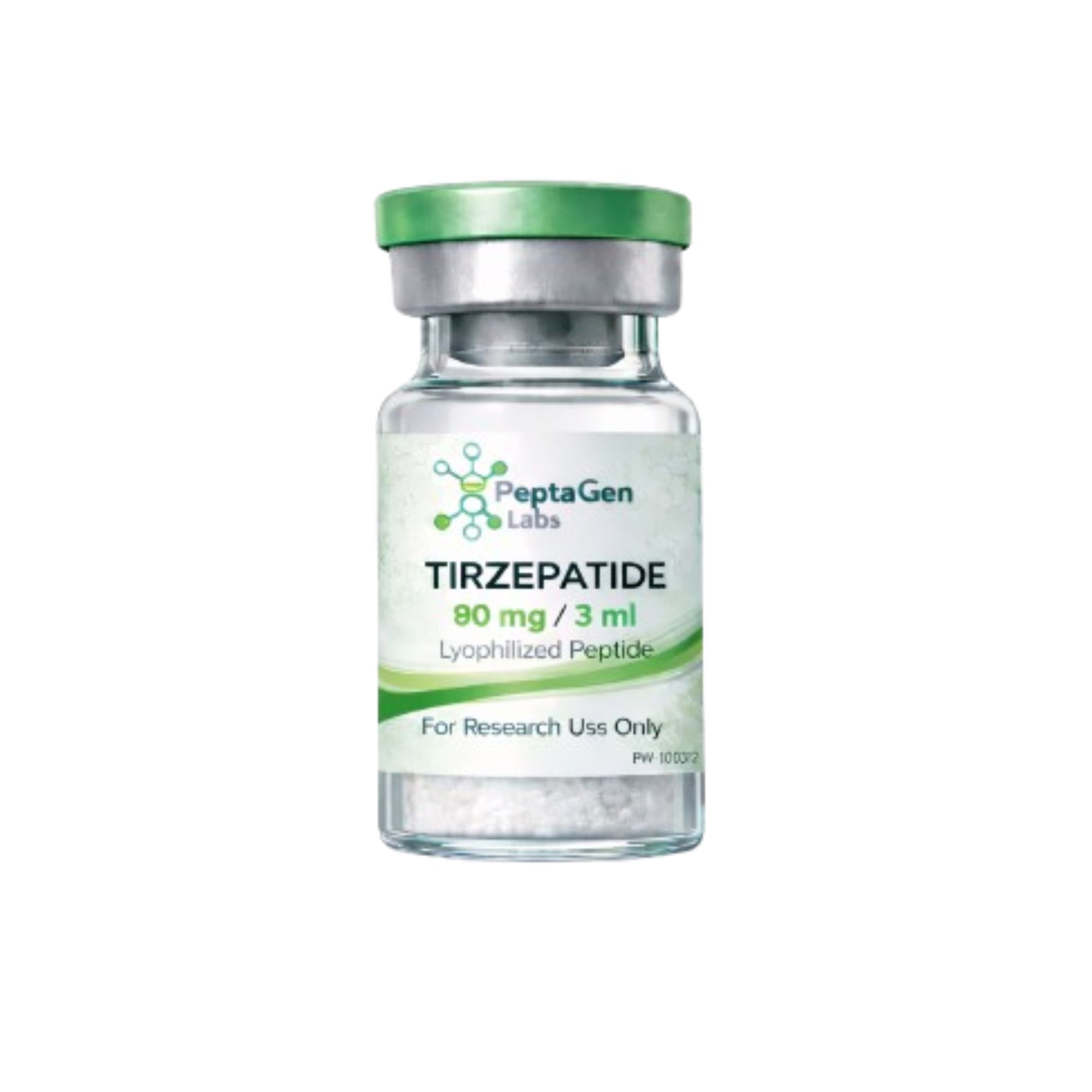
Tirzepatide 90mg Vial – Advanced Research Peptide
Tirzepatide 90mg is a synthetic peptide research compound investigated for its activity at two important metabolic hormone receptors: the glucose-dependent insulinotropic polypeptide (GIP) receptor and the glucagon-like peptide-1 (GLP-1) receptor.
This dual-receptor activity is the defining scientific characteristic of Tirzepatide 90mg and has made tirzepatide an important subject of metabolic and endocrine research. Unlike compounds that primarily focus on a single receptor pathway, tirzepatide interacts with both GIP and GLP-1 receptor systems, allowing researchers to investigate how these pathways work together.
Tirzepatide is a 39-amino-acid synthetic peptide with a fatty-acid component that contributes to its extended biological activity. Public chemical databases identify tirzepatide as a dual GIP and GLP-1 receptor agonist, with a molecular weight of approximately 4813 g/mol for the free form.
Research involving Tirzepatide 90mg can focus on hormone receptor signalling, glucose metabolism, appetite-related pathways, energy balance, and broader metabolic processes.
This product is supplied strictly for laboratory and scientific research purposes.
Not for human use. Not for veterinary use.
What Is Tirzepatide 90mg?
Tirzepatide 90mg is a research-grade formulation containing tirzepatide, a synthetic dual GIP and GLP-1 receptor agonist.
Tirzepatide is structurally based on a modified peptide sequence related to GIP. Its molecular design includes a C20 fatty diacid component attached through a linker, which contributes to its pharmacological characteristics.
The compound has become particularly interesting in research because GIP and GLP-1 are both involved in metabolic signalling.
Researchers studying Tirzepatide 90mg can therefore examine how simultaneous activation of these receptor pathways influences biological systems.
Research areas associated with tirzepatide include:
- GIP receptor signalling
- GLP-1 receptor signalling
- Glucose metabolism
- Incretin biology
- Appetite-related pathways
- Energy balance
- Metabolic regulation
- Endocrine signalling
- Body-weight research
- Nutrient metabolism
Understanding the GIP Receptor
GIP stands for glucose-dependent insulinotropic polypeptide.
It is an incretin hormone involved in nutrient-related signalling and metabolic regulation.
The GIP receptor is therefore an important target in metabolic research.
Tirzepatide 90mg is investigated partly because of its ability to activate the GIP receptor.
Researchers can use this activity to investigate questions surrounding:
- Incretin signalling
- Glucose-dependent responses
- Nutrient sensing
- Metabolic regulation
- Hormonal communication
- Energy metabolism
Studying GIP receptor activity alongside GLP-1 receptor activity provides researchers with an opportunity to examine interactions between two major incretin pathways.
Understanding the GLP-1 Receptor
GLP-1, or glucagon-like peptide-1, is another important hormone involved in metabolic signalling.
GLP-1 receptor activity has been extensively studied in relation to glucose regulation, pancreatic signalling, gastrointestinal processes, and appetite-related pathways.
Because Tirzepatide 90mg activates the GLP-1 receptor as well as the GIP receptor, researchers can investigate the combined effects of these two signalling systems.
Research involving the GLP-1 component may focus on:
- Glucose-related signalling
- Incretin biology
- Appetite pathways
- Nutrient response
- Endocrine regulation
- Metabolic adaptation
How Tirzepatide 90mg Works in Research
The primary research interest in Tirzepatide 90mg comes from its dual receptor activity.
Instead of examining GIP and GLP-1 signalling independently, researchers can investigate what happens when both pathways are activated by the same experimental compound.
This provides a useful model for studying interactions between different metabolic hormone systems.
Research may evaluate:
- Receptor activation
- Hormonal signalling
- Glucose metabolism
- Energy intake
- Appetite-related responses
- Metabolic markers
- Changes in body-weight models
- Nutrient utilisation
The specific results depend on the research model, experimental design, exposure period, and other variables.
Tirzepatide 90mg and Metabolic Research
Metabolism is controlled by a complex network of hormones, receptors, enzymes, and cellular processes.
GIP and GLP-1 are two important components of this network.
Researchers studying Tirzepatide 90mg can examine how simultaneous activation of these receptors affects broader metabolic processes.
Areas of investigation may include:
- Glucose homeostasis
- Energy metabolism
- Nutrient utilisation
- Hormonal responses
- Appetite signalling
- Insulin-related pathways
- Metabolic adaptation
This makes tirzepatide relevant to a wide range of experimental research involving endocrine and metabolic biology.
Tirzepatide 90mg and Glucose Research
Glucose regulation is one of the most extensively studied areas associated with GIP and GLP-1 receptor signalling.
These incretin pathways participate in the body’s response to nutrient intake and are closely connected to glucose-dependent physiological processes.
Tirzepatide 90mg provides researchers with a model for studying both receptor systems simultaneously.
Experimental research may investigate:
- Glucose metabolism
- Glucose-dependent hormone responses
- Insulin-related signalling
- Incretin activity
- Metabolic regulation
- Changes in glucose-related biomarkers
These studies can contribute to a broader understanding of how incretin receptor pathways influence metabolic function.
Tirzepatide 90mg and Appetite Research
Appetite is influenced by a complex interaction between hormonal, neurological, gastrointestinal, and metabolic signals.
GLP-1 signalling has been widely studied in relation to appetite and food-intake pathways.
GIP also participates in nutrient-related signalling.
The dual activity of Tirzepatide 90mg allows researchers to investigate how GIP and GLP-1 pathways may interact in experimental models involving appetite and energy intake.
Research may examine:
- Food intake
- Appetite-related signalling
- Satiety-associated pathways
- Energy intake
- Hormonal responses
- Metabolic behaviour
These findings are useful for understanding the biological relationship between incretin signalling and energy balance.
Tirzepatide 90mg and Energy Balance
Energy balance is determined by the relationship between energy intake and energy expenditure.
Hormonal pathways influence both sides of this relationship.
Because Tirzepatide 90mg acts through two metabolic hormone receptors, researchers can investigate how combined receptor activation influences energy-related processes.
Research areas can include:
- Energy intake
- Energy expenditure
- Nutrient utilisation
- Metabolic activity
- Appetite signalling
- Body-weight models
- Hormonal regulation
This makes tirzepatide an interesting experimental tool for studying interconnected metabolic systems.
Tirzepatide 90mg and Body-Weight Research
Tirzepatide has been investigated extensively in research involving body-weight and metabolic outcomes.
However, it is important to distinguish between scientific research findings and product claims.
Research involving Tirzepatide 90mg should be described in terms of the biological processes and experimental observations being studied rather than presenting those observations as guaranteed outcomes.
Researchers may examine changes in:
- Body weight
- Energy intake
- Metabolic markers
- Appetite-related signalling
- Glucose-related measurements
- Hormonal responses
Results can differ depending on the experimental population and study design.
Tirzepatide 90mg and Incretin Research
Incretins are hormones released in response to nutrient intake.
GIP and GLP-1 are two major incretin-related hormones that have become central to metabolic research.
The dual activity of Tirzepatide 90mg makes it particularly relevant to studies investigating incretin biology.
Researchers can explore how simultaneous receptor activation affects:
- Hormonal signalling
- Glucose metabolism
- Nutrient response
- Appetite pathways
- Energy balance
- Metabolic regulation
This allows researchers to study interactions between two related but distinct endocrine pathways.
Why Dual-Receptor Activity Matters
Single-pathway research can provide valuable information about individual receptors.
However, biological systems rarely operate through one pathway in isolation.
GIP and GLP-1 signalling are interconnected with broader endocrine and metabolic systems.
Tirzepatide 90mg offers an experimental approach for investigating both receptor pathways at the same time.
This can help researchers examine questions such as:
- How do GIP and GLP-1 pathways interact?
- Does combined receptor activation change metabolic signalling?
- How does dual activation influence glucose-related processes?
- How are appetite-related pathways affected?
- What changes occur in energy metabolism?
These questions are central to ongoing metabolic research.
Tirzepatide 90mg Compared With Single-Receptor Research
Tirzepatide differs from compounds that selectively target only one incretin receptor.
Its dual GIP and GLP-1 activity allows researchers to examine a broader signalling profile.
This distinction is particularly useful when designing comparative experiments.
Researchers may compare:
- GLP-1 receptor activation
- GIP receptor activation
- Combined GIP and GLP-1 activation
- Changes in metabolic markers
- Hormonal responses
- Energy-related outcomes
Such comparisons can help researchers understand how individual and combined receptor pathways contribute to metabolic regulation.
Tirzepatide 90mg Molecular Structure
Tirzepatide is a synthetic peptide consisting of 39 amino acids and incorporates a C20 fatty diacid moiety connected through a linker.
This structural modification is an important part of the compound’s research profile.
The molecular formula for tirzepatide is reported as C225H348N48O68, with a molecular weight of approximately 4813 g/mol.
Researchers studying Tirzepatide 90mg should distinguish between the active peptide itself and any particular salt or formulation used for laboratory purposes, as these can have different molecular characteristics.
Tirzepatide 90mg and Hormone Receptor Signalling
Hormone receptors allow cells to respond to specific biological signals.
GIP and GLP-1 receptors belong to the broader family of receptors involved in endocrine and metabolic communication.
Research using Tirzepatide 90mg can investigate how activation of these receptors affects downstream signalling.
Laboratory research may examine:
- Receptor binding
- Signal transduction
- Hormonal responses
- Cellular signalling
- Metabolic gene expression
- Glucose-related pathways
These investigations can provide information about the relationship between receptor activity and metabolic function.
Tirzepatide 90mg and Cellular Research
Although much of the interest surrounding tirzepatide is associated with whole-organism metabolic research, receptor signalling can also be studied at the cellular level.
Researchers may investigate how GLP-1 and GIP receptor activation affects cellular responses under controlled conditions.
Potential research measurements include:
- Receptor expression
- Signal activation
- Intracellular responses
- Hormonal signalling
- Metabolic activity
- Gene-expression changes
These approaches allow scientists to investigate the underlying mechanisms associated with dual-receptor activation.
Tirzepatide 90mg Research Applications
The broad research applications of Tirzepatide 90mg include several areas of metabolic and endocrine science.
GIP Receptor Research
Investigation of GIP receptor activity and nutrient-related signalling.
GLP-1 Receptor Research
Study of GLP-1 receptor signalling and metabolic responses.
Incretin Biology
Research into the interaction between GIP and GLP-1 pathways.
Glucose Metabolism
Investigation of glucose-related metabolic processes.
Appetite Research
Study of hormonal pathways associated with appetite and energy intake.
Energy Balance
Research into energy utilisation, intake, and metabolic regulation.
Endocrine Research
Investigation of hormone receptor communication.
Metabolic Research
Study of interconnected metabolic pathways and physiological responses.
Body-Weight Research
Experimental investigation of body-weight and energy-balance models.
Why Choose Tirzepatide 90mg?
The Tirzepatide 90mg format provides a defined quantity of tirzepatide for laboratory and scientific research.
Its primary research value comes from its dual GIP and GLP-1 receptor activity.
The 90mg format may be relevant to research programs that require a larger defined quantity of material for structured laboratory investigations.
The quantity stated on the vial represents the amount of research material supplied and should not be interpreted as a recommended human dose.
Tirzepatide 90mg Product Format
Our Tirzepatide 90mg is supplied as a lyophilised research peptide.
Lyophilisation provides a dry research format that can be appropriate for laboratory storage and subsequent preparation according to validated experimental procedures.
Product Specifications
Product: Tirzepatide
Quantity: 90mg
Form: Lyophilised peptide powder
Peptide length: 39 amino acids
Primary targets: GIP receptor and GLP-1 receptor
Molecular formula: C225H348N48O68
Molecular weight: Approximately 4813 g/mol
Research category: Metabolic research peptide
Research areas: GIP signalling, GLP-1 signalling, incretin research, glucose metabolism, appetite pathways, energy balance
Intended use: Laboratory and scientific research
Human use: Not intended
Veterinary use: Not intended
The molecular characteristics above refer to tirzepatide as reported in public chemical databases; specific formulation or salt forms may differ.
Laboratory Handling of Tirzepatide 90mg
Tirzepatide 90mg should be handled according to established laboratory procedures appropriate for synthetic peptide research materials.
Preparation requirements depend on the experimental design, analytical method, concentration requirements, and validated laboratory protocol.
Researchers should consult the applicable product documentation and safety information before handling the material.
Consistent laboratory procedures can help reduce variation between experimental preparations.
This product page does not provide human dosing, injection, administration, or personal-use instructions.
Storage of Tirzepatide 90mg
Appropriate storage is important for maintaining the integrity of peptide research materials.
Researchers should follow the storage conditions provided with the relevant product and batch.
General laboratory considerations include:
- Protecting the material from excessive heat
- Protecting the vial from direct light
- Maintaining appropriate storage conditions
- Minimising unnecessary environmental exposure
- Keeping the container appropriately sealed
- Avoiding unnecessary temperature fluctuations
- Following validated laboratory procedures
Where a laboratory prepares research solutions, storage should follow the validated protocol established for that particular experiment.
Research Quality and Reproducibility
Reproducibility is an important consideration when conducting peptide research.
Factors such as peptide identity, purity, concentration, storage conditions, preparation method, and experimental environment can influence results.
Researchers working with Tirzepatide 90mg should maintain appropriate records covering:
- Product identification
- Batch or lot information
- Quantity
- Storage conditions
- Preparation method
- Experimental concentration
- Research model
- Observation period
- Analytical methodology
- Results
Detailed records can make it easier to compare findings across experiments and identify potential sources of variation.
Safety and Limitations of Tirzepatide 90mg
Tirzepatide has been investigated extensively in clinical research, but a research-grade product should not automatically be represented as an approved or appropriate product for personal use.
Research findings depend on the specific formulation, study population, protocol, exposure, and experimental conditions.
Clinical studies have reported gastrointestinal adverse reactions among participants, and researchers should consult the current scientific literature and relevant safety documentation when assessing the compound.
For laboratory research, appropriate risk-management procedures should be followed.
Understanding Tirzepatide Research Results
Research findings involving Tirzepatide 90mg should always be interpreted within the context of the study in which they were generated.
A result observed in one experimental model may not necessarily occur in another.
Important variables can include:
- Experimental model
- Study population
- Concentration
- Exposure duration
- Research conditions
- Analytical methodology
- Baseline metabolic characteristics
- Receptor expression
For this reason, laboratory findings should not automatically be presented as predictable outcomes in humans.
Frequently Asked Questions
What is Tirzepatide 90mg?
Tirzepatide 90mg is a synthetic peptide research material investigated for its dual activity at the GIP and GLP-1 receptors.
What receptors does tirzepatide target?
Tirzepatide is a dual GIP and GLP-1 receptor agonist.
Is Tirzepatide a peptide?
Yes. Tirzepatide is a synthetic peptide consisting of 39 amino acids with a lipid-containing structural modification.
Why is tirzepatide studied?
Researchers investigate tirzepatide in areas including incretin signalling, glucose metabolism, appetite-related pathways, energy balance, and broader metabolic regulation.
What does dual agonist mean?
Dual agonist means that a compound activates two different receptor pathways. In the case of tirzepatide, these are the GIP and GLP-1 receptors.
What is GIP?
GIP is glucose-dependent insulinotropic polypeptide, an incretin hormone involved in nutrient-related and metabolic signalling.
What is GLP-1?
GLP-1 is glucagon-like peptide-1, an incretin hormone involved in several processes associated with glucose metabolism and appetite-related signalling.
Is Tirzepatide the same as a GLP-1-only compound?
No. Tirzepatide 90mg has activity at both GIP and GLP-1 receptors, giving it a dual-receptor research profile.
What is the molecular weight of tirzepatide?
Tirzepatide has a reported molecular weight of approximately 4813 g/mol in its free form.
What is the molecular formula of tirzepatide?
The reported molecular formula is C225H348N48O68 for tirzepatide.
What does the 90mg specification mean?
The 90mg specification identifies the stated quantity of research material contained in the vial. It is not a recommended human administration amount.
What form is Tirzepatide 90mg supplied in?
Tirzepatide 90mg is supplied as a lyophilised research peptide.
Is Tirzepatide 90mg intended for human use?
No. This product is supplied strictly for laboratory and scientific research purposes and is not intended for human use.
Is Tirzepatide 90mg intended for animals?
No. The product is not intended for veterinary or animal use.
Can Tirzepatide 90mg be marketed as a weight-loss treatment?
No. A research product should not be represented as a treatment or guaranteed weight-loss product. Research findings should be described within their appropriate scientific context.
What research areas are associated with Tirzepatide 90mg?
Research areas include GIP receptor signalling, GLP-1 receptor signalling, incretin biology, glucose metabolism, appetite pathways, energy balance, endocrine signalling, and metabolic research.
Important Research-Use Disclaimer
Tirzepatide 90mg is supplied strictly for laboratory, analytical, and scientific research purposes only.
This product is not intended for human consumption, human administration, veterinary use, diagnosis, treatment, prevention, or cure of any disease or medical condition.
Information concerning GIP signalling, GLP-1 signalling, glucose metabolism, incretin biology, appetite pathways, energy balance, body-weight research, and metabolic regulation is provided for scientific and educational purposes only.
Research findings should not be interpreted as a recommendation for personal use or as proof that this research material is suitable for human administration.
Researchers are responsible for ensuring that their use of Tirzepatide 90mg complies with applicable laws, regulations, institutional requirements, laboratory safety procedures, and ethical standards.
For research use only. Not for human or veterinary use.


